
EarDiTech develops precision diagnostics and augmented hearing technologies grounded in more than a decade of auditory neuroscience research at Ghent University. This page summarises the scientific basis behind our CochSyn diagnostic test and CoNNear hearing compensation technology. For a concise overview of performance results, see our Solutions page.
Hearing loss is not a single problem. Standard hearing loss is typically associated with outer hair cell (OHC) damage and elevated hearing thresholds, the type of loss that conventional hearing-aid algorithms are designed to compensate for.
Hidden hearing loss, or cochlear synaptopathy (CS), is different. It involves the loss of auditory nerve fibre synapses at the inner hair cells, caused by aging, noise exposure, or ototoxicity. Because CS does not directly affect hearing sensitivity, audiometric thresholds can remain normal, which is why this form of damage is called “hidden”.
Healthy ears have 15 to 19 auditory nerve fibres per inner hair cell. When these synapses are lost, the brain receives a degraded neural representation of sound, especially in noisy or challenging listening conditions, even though a standard hearing test may show no abnormality.

Cochlear synaptopathy is expected to affect a large part of the population. It precedes outer hair cell damage in the progression of sensorineural hearing loss and is one of the earliest signs that hearing is deteriorating, often before any decline is visible on a standard audiogram.
People with hidden hearing loss frequently report difficulty understanding speech in noise, yet receive no diagnosis or targeted treatment because their audiogram appears normal. Standard hearing aids focus on gain and compression to restore audibility; they cannot correct the complex neural distortions caused by synaptopathy.
There is currently no standard clinical test for cochlear synaptopathy. EarDiTech aims to fill this gap with the CochSyn test and to enable personalised hearing compensation through the CoNNear algorithm.
The Envelope-Following Response (EFR) is a non-invasive electrophysiological measure recorded from the scalp using the same technique as a standard auditory brainstem response (ABR). It reflects how the brainstem encodes the temporal envelope of sound at supra-threshold levels.
In the CochSyn test, a patented rectangularly amplitude-modulated (RAM) stimulus is presented monaurally at 70 dB SPL through insert earphones while scalp electrodes record the neural response (800 repeats per condition). The strength of the resulting EFR, quantified as the sum of the first four modulation harmonics, is proportional to the degree of cochlear synaptopathy. The patient’s cochlear gain is personalised from their audiogram, and the measured EFR is compared against auditory model simulations across seven auditory nerve fibre survival profiles. Classification accuracy for identifying the correct CS profile from a single 4 kHz measurement is 68.6%.
EFR markers are more selective to cochlear synaptopathy than ABR wave-I amplitudes, which are strongly confounded by outer hair cell damage, and show better test-retest reliability across repeated sessions.

Clinical studies with up to 119 participants (ages 18 to 83) have validated the CochSyn approach (clinical trial NCT06114680).
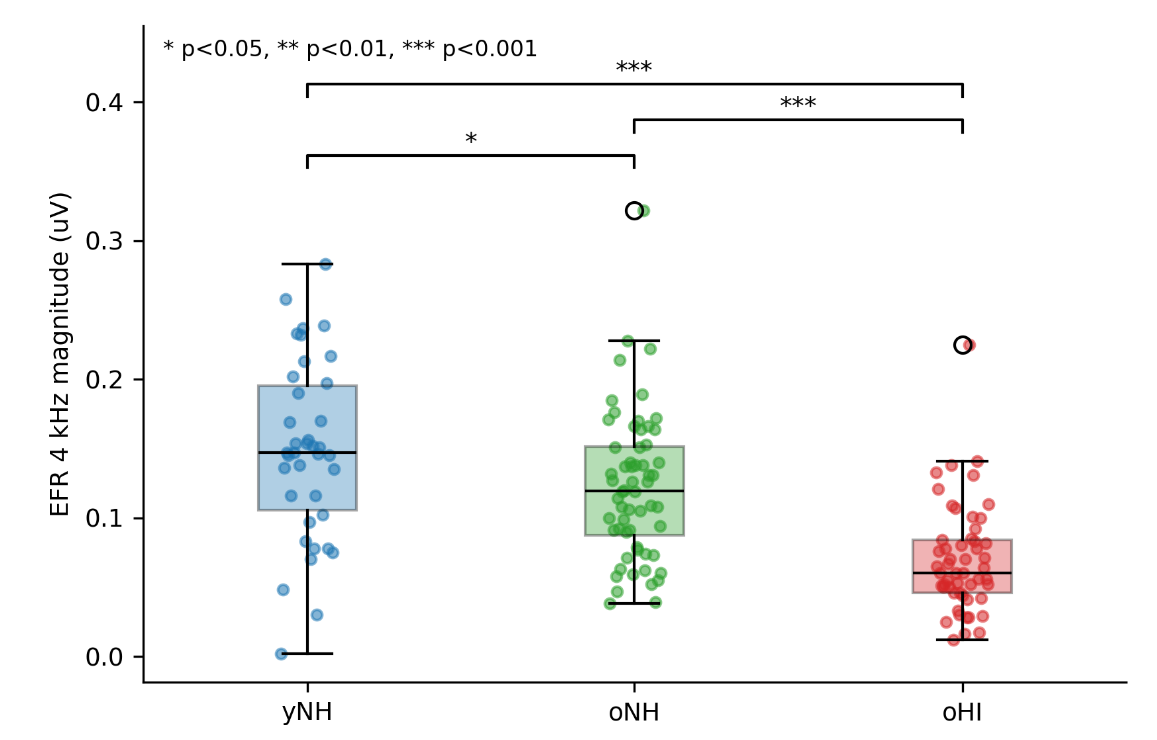
EFR by participant group (CochSyn study): Envelope-following responses were measured with the CochSyn device across four participant groups: young (y), older (o), normal-hearing (NH), and hearing-impaired (HI). Pairwise statistical comparisons show significant differences between all groups. Younger participants with normal hearing show the strongest EFRs. Older participants show reduced EFR strength consistent with age-related synaptopathy. Hearing-impaired participants show additional reduction beyond age effects, reflecting the combined impact of outer hair cell damage and cochlear synaptopathy. This pattern matches predictions from auditory neuroscience models and supports EFR as a marker sensitive to both aging and hearing damage.

The evidence below comes from foundational auditory neuroscience research. It shows that cochlear synaptopathy reduces envelope-following responses before audiometric thresholds decline, establishing a biological basis for the CochSyn marker.
In animal models, kainic-acid-induced cochlear synaptopathy reduces or abolishes EFR strength, consistent with the loss of auditory nerve fibre synapses. ABR wave-I amplitude has been shown to be proportional to the surviving IHC-ANF synapse population when other forms of sensorineural hearing loss are absent.
Noise exposure and aging studies in mice and humans demonstrate progressive auditory nerve fibre loss that precedes detectable hair cell damage, supporting the hypothesis that hidden hearing loss is an early, prevalent stage in the progression of sensorineural hearing loss.


The standard audiogram measures hearing sensitivity at a handful of frequencies and primarily reflects outer hair cell function. The EFR marker reflects supra-threshold neural encoding of temporal envelope cues. These measures are not interchangeable: they capture different aspects of auditory function.
In participants without self-reported hearing difficulties, EFR strength showed no relationship to audiometric thresholds, yet listeners with normal audiograms can still have reduced EFRs. In participants who did report difficulties, weaker EFRs were significantly associated with poorer speech-in-noise performance.
When EFR is added to a model that predicts speech-in-noise (SPIN) performance from audiogram values alone, it makes a significant additional contribution. This supports using EFR alongside the audiogram, not as a replacement for it.
Together, a normal audiogram, reduced EFR, and functional listening deficits can identify the hidden hearing loss profile that the CochSyn test is designed to detect.
CoNNear is a convolutional neural-network implementation of biophysically realistic auditory models (cochlea, inner hair cell, auditory nerve). It enables a closed-loop framework for designing personalised hearing compensation:

Separate compensation strategies target outer hair cell damage (frequency-dependent gain) and cochlear synaptopathy (temporal envelope shaping without additional gain). A combined OHC+CS algorithm addresses patients suffering from both forms of damage.
The following results demonstrate that CoNNear compensation improves sound quality, speech intelligibility, and phoneme accuracy while running at low latency suitable for real-time hearable applications. Full result figures are also presented on our Solutions page.
HASPI (objective): The Hearing Aid Speech Perception Index (HASPIv2) predicts speech intelligibility from the temporal envelope and temporal fine structure of the processed signal. It was computed for unprocessed, NAL-NL2 (industry standard), OHC (our outer hair cell compensation), CS (cochlear synaptopathy compensation), and combined OHC+CS conditions using a free-field setup with a head-and-torso simulator and eight-loudspeaker ring at -3 dB SNR babble noise. Higher HASPI scores indicate better predicted intelligibility. OHC compensation reaches a HASPI score of 0.92, compared to 0.46 unprocessed and 0.53 for NAL-NL2.

MUSHRA (patient testing, n = 14): Fourteen listeners rated the quality of unprocessed and OHC-compensated sound samples across speech in quiet (SiQ), speech in noise (SiN), classical music, and pop music. Ratings were compared against NAL-NL2 reference processing. Green cells indicate the processed sound was rated better than unprocessed; red indicates worse; a + marks conditions significantly better than NAL-NL2.

Phoneme accuracy (objective): Normalised root-mean-square error (NRMSE) quantifies the difference between auditory-nerve population responses in a hearing-impaired model and a normal-hearing reference model. It was computed across TIMIT phoneme categories (550 utterances, 50 to 90 dB SPL) for unprocessed, industry-reference, and CoNNear-processed conditions. A lower NRMSE indicates processing closer to normal hearing and better predicted speech understanding. CoNNear consistently reduces NRMSE compared to unprocessed and industry-reference processing.

Speech intelligibility (patient testing, n = 14): Fourteen participants completed a Dutch/Flemish matrix sentence test measuring word recognition at a fixed signal-to-noise ratio. Scores were compared between unprocessed and OHC-compensated conditions in a paired design. On average, patients showed a 12.5% improvement in speech understanding. Statistical significance was assessed with the Wilcoxon signed-rank test (p < 0.001).

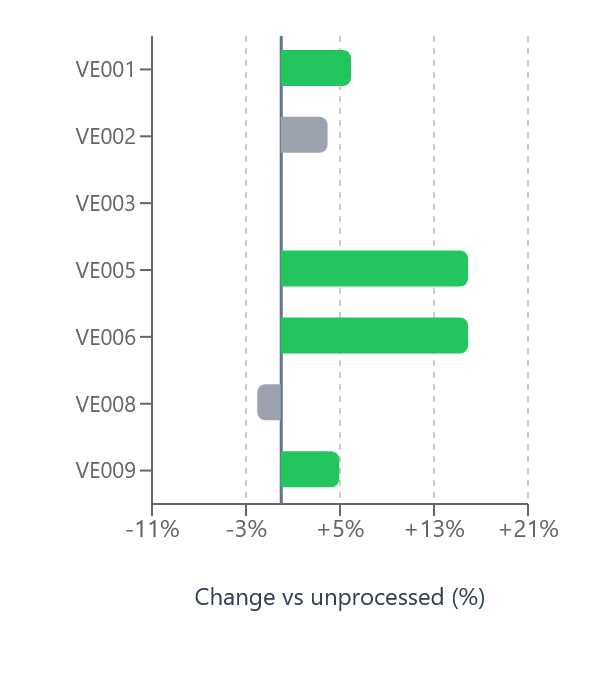
Algorithm comparison (ongoing study): In an ongoing clinical study, patients listen to speech processed with different hearing-aid algorithms, OHC (outer hair cell compensation), CS (cochlear synaptopathy compensation), and OHC+CS (combined), compared to unprocessed audio.
CS (cochlear synaptopathy compensation)
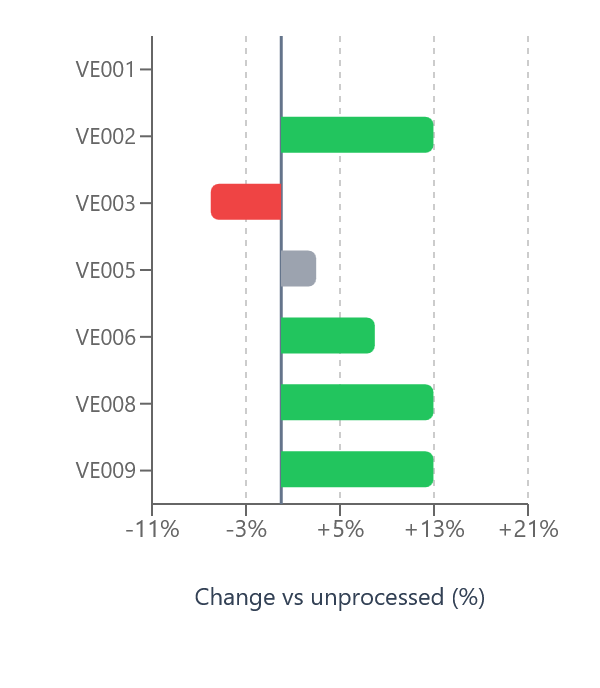
OHC+CS (combined compensation)
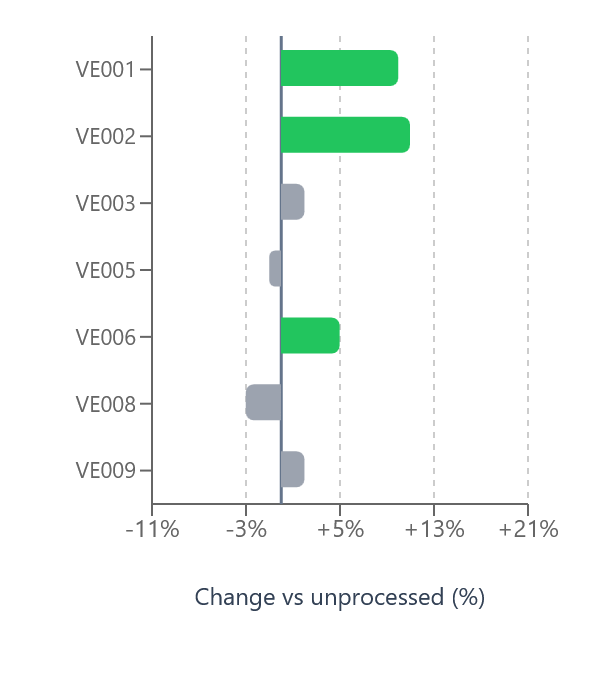
OHC (outer hair cell compensation)
Latency: CoNNear runs at 4.49 ms latency, matching or outperforming leading commercial hearing devices. End-to-end latency was measured using an artificial ear and microphone. For competitor devices, unrelated delays were subtracted by comparing measurements with and without the earpiece inserted. For the OHC real-time processing setup, latency was determined as the difference between playback without processing and playback with CoNNear processing enabled.

CochSyn enables earlier and more accurate assessment of hearing damage, including hidden hearing loss that standard audiograms cannot detect. Beyond personalised hearing-aid fitting, EFR monitoring supports preventive and clinical applications where neural hearing damage must be identified before it becomes irreversible.
De Poortere et al. (2026) showed that large-scale music events can cause subclinical hearing damage. EFR-based monitoring can detect this neural damage earlier than conventional audiometry, supporting preventive strategies for high-risk populations such as concert-goers and musicians.
Van Der Biest et al. (2026) demonstrated that EFR markers can reveal sensorineural hearing loss after platinum-based chemotherapy before conventional tests, enabling earlier clinical intervention during cancer treatment.
Research supported by the European Innovation Council Transition grant EarDiTech (101058278). Clinical trials: NCT06114680 (CochSyn diagnostic), NCT07091071 (hearing-aid evaluation).